
JVC Car Stereo Manual: A Comprehensive Guide (Updated 12/16/2025)
Welcome! This detailed manual, updated today – 12/16/2025 – provides comprehensive support for your JVC car stereo, leveraging resources like the Internet Archive.
Explore detailed instructions, troubleshooting, and feature explanations to maximize your in-car audio experience.
JVC, a renowned name in audio technology, has a long-standing history of producing high-quality car stereos. These head units are designed to enhance your driving experience with superior sound, innovative features, and reliable performance. From basic models offering essential radio and CD playback to advanced systems with Bluetooth connectivity, smartphone integration, and powerful amplification, JVC caters to a diverse range of automotive audio needs.
Understanding your JVC car stereo is crucial for unlocking its full potential. This guide serves as a central resource, providing detailed information on operation, settings, troubleshooting, and more. Whether you’re a first-time user or a seasoned car audio enthusiast, this manual will empower you to confidently navigate and customize your JVC head unit. We will explore the core functionalities and delve into the advanced features that set JVC stereos apart, ensuring a seamless and enjoyable audio experience on the road.

This introduction sets the stage for a comprehensive exploration of your JVC car stereo system.
Understanding JVC Head Unit Models
JVC offers a diverse lineup of head unit models, each tailored to specific needs and budgets. Generally, models are categorized by features and functionality. Single-DIN units are the standard size, fitting into most vehicle dashboards, while Double-DIN units offer larger displays and expanded capabilities.
Entry-level models typically focus on core features like AM/FM radio, CD playback, and basic USB connectivity. Mid-range units add Bluetooth for wireless audio streaming and hands-free calling, alongside enhanced sound customization options. Premium models boast advanced features such as Apple CarPlay and Android Auto integration, high-resolution audio playback, and powerful built-in amplifiers.
Key specifications to consider include power output (watts RMS), pre-amp outputs for external amplifiers, and display type (LCD, LED, or touchscreen). Identifying your specific model number is vital for accessing the correct manual and support resources, ensuring optimal performance and enjoyment of your JVC car stereo.
Locating Your JVC Car Stereo Manual
Finding the correct manual for your JVC car stereo is crucial for understanding its features and troubleshooting any issues. Several resources are available to assist you. JVC’s Official Website maintains an archive of manuals, searchable by model number. This is the most reliable source for accurate and up-to-date documentation.
Alternatively, Third-Party Manual Databases, like the Internet Archive, often host user-submitted manuals. However, verify the manual’s compatibility with your specific model. Before searching, Identifying Your Specific Model Number is essential. This is usually found on the unit’s faceplate, the original packaging, or a sticker on the device’s side or back.
Having the model number allows for a precise search, ensuring you download the correct manual and avoid confusion. A correct manual will unlock the full potential of your JVC stereo.
JVC’s Official Website Manual Archive
JVC’s official website provides a dedicated archive for car stereo manuals, representing the most dependable source for accurate information. Navigating to the support section of JVC’s website allows users to search for manuals using their specific model number. This ensures compatibility and avoids downloading incorrect documentation.
The archive typically includes downloadable PDF versions of owner’s manuals, installation guides, and sometimes even service manuals. These resources cover a wide range of JVC head units, from older models to the latest releases. The website’s search function is generally robust, allowing for precise results.
Regularly updated, JVC’s archive is the first place to look when seeking assistance with your car stereo. It offers a direct line to the manufacturer’s official guidance.
Third-Party Manual Databases
While JVC’s official website is the primary source, several third-party manual databases can supplement your search for a JVC car stereo manual. Websites like ManualsLib and similar online repositories often host user-uploaded manuals, potentially including models no longer actively supported by JVC.
However, exercise caution when using these resources. Verify the manual’s authenticity and ensure it corresponds precisely to your head unit’s model number. Information accuracy can vary, and some manuals may be incomplete or outdated. These databases can be useful when the official archive lacks your specific model.

Always cross-reference information found on third-party sites with other sources whenever possible to confirm its validity. Consider these databases as a secondary option, prioritizing JVC’s official documentation.
Identifying Your Specific Model Number
Locating your JVC car stereo’s model number is crucial for finding the correct manual and support information. The model number is typically found on the front panel of the head unit, often near the display screen or below the buttons. It’s usually a combination of letters and numbers.
Alternatively, check the sides or top of the unit. Some models have a label affixed to these areas containing the model number and serial number. If the unit was professionally installed, the model number might be listed on the original installation paperwork or receipt.
For built-in systems, consult your vehicle’s owner’s manual, as it may list the JVC model integrated into the dashboard. Accurate identification ensures you download the correct documentation for your specific JVC car stereo.
Basic Operations & Features
Familiarizing yourself with the fundamental operations of your JVC car stereo is the first step to enjoying its features. The power button, usually prominently displayed, initiates and terminates the unit’s operation. Volume control is typically managed via a rotary knob or digital buttons, allowing for precise audio level adjustments.
Source selection enables you to switch between various audio inputs, including FM/AM radio, CD playback (if equipped), USB drives, and Bluetooth-connected devices. Each source offers unique functionalities and settings.
Tuning into radio stations involves scanning frequencies or directly entering a station number. Preset functions allow you to save your favorite stations for quick access, enhancing your listening experience on the go. These core features form the foundation of your JVC stereo’s usability.
Powering On/Off and Volume Control
Initiating your JVC car stereo is typically achieved by pressing the clearly marked power button. A short press usually activates the unit, while a sustained press may trigger a complete shutdown. Some models feature automatic power-on with ignition, streamlining the startup process.
Volume adjustment is crucial for optimal listening. JVC stereos commonly employ a rotary encoder knob for intuitive volume control. Digital up/down buttons provide precise adjustments, and steering wheel controls (if integrated) offer convenient access.
Muting functionality, often accessible via a dedicated button or on-screen option, instantly silences the audio output. Remember to check your specific model’s manual for unique power and volume control features.
Source Selection (FM/AM, CD, USB, Bluetooth)
Navigating between audio sources on your JVC car stereo is straightforward. A dedicated “Source” or “Input” button cycles through available options: FM/AM radio, CD player (if equipped), USB drives, and Bluetooth connectivity.
FM/AM tuning allows access to local radio stations. CD playback requires a compatible disc inserted correctly. USB functionality enables music playback from connected storage devices, supporting common formats like MP3 and WMA.
Bluetooth pairing connects wirelessly to smartphones and other devices for audio streaming. Ensure Bluetooth is enabled on both devices for successful connection. The selection process is often visually confirmed on the head unit’s display, indicating the active source. Refer to your model’s manual for specific source selection procedures.
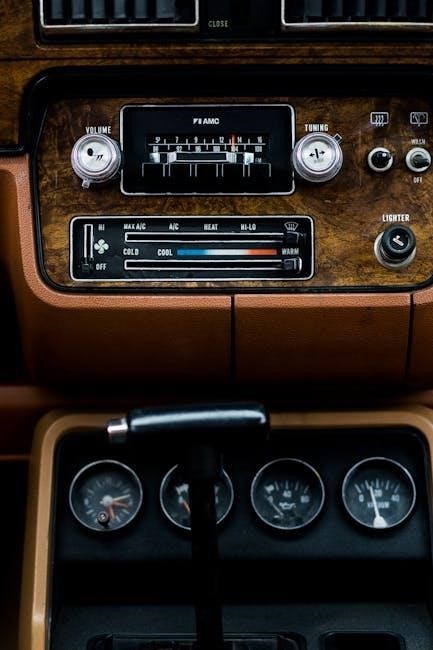
Tuning and Presetting Radio Stations
Tuning into your favorite radio stations is achieved through several methods on your JVC car stereo. Utilize the tuning knob or arrow buttons to scan frequencies. For precise tuning, consider the “Seek” function, which automatically stops at the next available station. Manual tuning offers greater control.
Presetting stations allows quick access to frequently listened-to channels. Typically, you’ll need to press and hold a numbered preset button while the desired station is playing. The unit will confirm the save.
Accessing presets is done by briefly pressing the corresponding preset button. Some models offer a preset scan feature, cycling through saved stations. Consult your specific model’s manual for detailed instructions on preset management and optimal tuning techniques.
Advanced Features & Settings
JVC car stereos boast a range of advanced features beyond basic operation. Explore the settings menu to unlock their full potential. This section delves into Bluetooth pairing for seamless audio streaming from smartphones and other devices, offering hands-free calling capabilities.
USB connectivity allows playback of digital music files stored on flash drives. Supported formats typically include MP3, WMA, and WAV. Further customization is available through the equalizer settings, enabling you to tailor the sound to your preferences. Adjust bass, treble, and mid-range frequencies for optimal audio clarity.
Advanced settings may include time alignment, crossover adjustments, and loudness control. Refer to your specific model’s manual for a comprehensive understanding of these features and their impact on sound quality.
Bluetooth Pairing and Audio Streaming
Establishing a Bluetooth connection with your smartphone or other compatible device is straightforward. First, ensure Bluetooth is enabled on both your JVC head unit and your external device. Navigate to the Bluetooth settings menu on the stereo – typically found under ‘Source’ or ‘Settings’.
Initiate pairing mode on the JVC unit. Your device should then detect the stereo; select it from the list of available devices. You may be prompted to enter a PIN code (often ‘0000’). Once paired, you can stream audio wirelessly.
Audio streaming allows you to enjoy music, podcasts, and other audio content directly from your device. Control playback from either the stereo or your device. Some JVC models also support Bluetooth calling, enabling hands-free operation.
USB Connectivity and File Playback
Connecting a USB device to your JVC car stereo allows for convenient playback of digital music files. Locate the USB port on your head unit – it’s usually on the front panel. Insert a USB drive containing compatible audio files (MP3, WMA, WAV, and FLAC are commonly supported).

File playback will typically begin automatically, or you may need to select ‘USB’ as the audio source. Use the stereo’s controls to navigate through folders and select tracks. Some JVC models support direct file selection and playlist creation via the head unit interface.
Ensure your USB drive is formatted with a compatible file system (FAT32 is generally recommended). Larger capacity drives may experience slower loading times. Regularly eject the USB drive safely through the stereo’s menu to prevent data corruption.
Equalizer and Sound Customization
JVC car stereos offer robust equalizer (EQ) settings to tailor the audio output to your preferences. Access the EQ settings through the stereo’s menu, typically found under ‘Audio’ or ‘Sound’. You’ll often find preset EQ curves like ‘Rock,’ ‘Pop,’ ‘Classical,’ and ‘Jazz’ for quick adjustments.
For more precise control, utilize the manual EQ settings. These allow you to adjust specific frequency bands – bass, mid-range, and treble – to fine-tune the sound. Experiment with boosting or reducing frequencies to enhance clarity, warmth, or punch.
Additional sound customization options may include a loudness function for increased bass at low volumes, a balance/fader control to adjust speaker levels, and a digital sound processor (DSP) for advanced audio shaping.
Understanding Display Indicators & Error Codes
Your JVC car stereo’s display utilizes various indicators to communicate its status. Common icons include power on/off, source selection (FM, AM, CD, USB, Bluetooth), and volume level. A ‘PAUSE’ or ‘PLAY’ icon signifies audio playback status. Watch for indicators related to Bluetooth connectivity, such as a paired device symbol.
Error codes are displayed when the unit encounters a problem. These codes, often numerical or alphanumeric, pinpoint the issue. Consult your specific model’s manual for a complete list and their meanings. Common errors relate to CD playback, USB device recognition, or Bluetooth pairing failures.
Understanding these indicators and codes is crucial for troubleshooting. If an error persists, note the code and refer to the troubleshooting section of this guide or JVC’s official support resources.
Common Error Messages and Troubleshooting
“No Disc” or “Error 42” often indicates a problem with the CD player – ensure a valid disc is inserted, clean the disc surface, or try a different disc. “USB Error” suggests an issue with the connected USB device; verify compatibility, try a different USB port, or format the drive.
Bluetooth pairing failures (often indicated by a flashing Bluetooth icon) can be resolved by deleting previous pairings on both the stereo and your device, then re-pairing. “Protected” messages on USB drives may mean the files are DRM-protected and incompatible.
If the display freezes, try a soft reset by holding the power button for 10 seconds. For persistent errors, consult the full manual or JVC support for advanced troubleshooting steps.
Display Brightness and Contrast Adjustment
Adjusting the display on your JVC car stereo ensures optimal visibility in varying lighting conditions. Access the display settings through the ‘Setup’ menu, typically navigated using the rotary encoder or touchscreen (depending on your model).
Brightness control ranges from low to high, allowing you to dim the screen for nighttime driving or increase it for clear viewing in bright sunlight. Contrast settings fine-tune the difference between light and dark elements, enhancing readability.
Experiment with these settings to find a balance that suits your preference and the ambient light. Some models offer an ‘Auto Dimming’ feature, which automatically adjusts brightness based on headlight usage. Refer to your specific model’s manual for detailed instructions.
Troubleshooting Common Issues
Encountering problems with your JVC car stereo? This section addresses frequent issues. First, check the fuse – a blown fuse is a common cause of no power. If the unit powers on but lacks sound, verify speaker connections and volume levels.
For Bluetooth issues, ensure your device is in pairing mode and within range. Try deleting and re-pairing the device. If the display freezes, a reset might be necessary (see ‘Factory Resetting’).
Sound distortion can indicate damaged speakers or incorrect equalizer settings. Consult the ‘Equalizer and Sound Customization’ section. If problems persist, consult a qualified car audio technician or JVC support for further assistance. Always refer to your specific model’s manual for detailed troubleshooting steps.
No Power/Unit Won’t Turn On
If your JVC stereo fails to power on, begin with the simplest checks. Verify the vehicle’s ignition is switched on, as the unit requires power from the car’s electrical system. Next, inspect the fuse associated with the stereo – a blown fuse is a frequent culprit. Locate the fuse box (consult your vehicle’s manual) and replace any damaged fuses with the correct amperage rating.
Check the wiring harness connecting the stereo to the car. Ensure all connections are secure and undamaged. A loose or corroded connection can prevent power delivery. If these steps fail, the unit itself may be faulty, requiring professional diagnosis or replacement.
Always disconnect the negative terminal of the car battery before working with electrical components.
Sound Distortion or No Sound
Experiencing sound distortion or complete silence? First, verify the volume level – it sounds basic, but it’s easily overlooked! Check the source selection; ensure the correct input (FM, CD, Bluetooth, etc.) is chosen. If using an auxiliary input, confirm the device is properly connected and the volume is up on that device too.
Inspect the speaker wiring for loose connections or damage. A faulty speaker wire can cause distortion or no sound from affected speakers. Adjust the equalizer settings; extreme settings can introduce distortion. If the problem persists, a speaker itself may be damaged and require replacement.
Consider a factory reset as a last resort, but remember this will erase custom settings.
Bluetooth Connection Problems

Difficulty pairing or maintaining a Bluetooth connection? Begin by ensuring Bluetooth is enabled on both your JVC head unit and your smartphone or device. Confirm your device is within range – typically within 30 feet. Delete any previous pairings on both devices and attempt the pairing process again from scratch.
Check for interference from other Bluetooth devices or wireless signals. Restart both your JVC stereo and your device; a simple reboot often resolves connectivity issues. Verify your device’s Bluetooth profile is compatible with the JVC unit (A2DP is essential for audio streaming).
If problems continue, consult your device’s manual for Bluetooth troubleshooting steps. A factory reset of the JVC unit might be necessary as a final measure.
JVC Steering Wheel Control Integration
Maintaining control while driving is paramount. JVC head units often support integration with your vehicle’s existing steering wheel controls. This allows you to adjust volume, change tracks, and answer calls without taking your hands off the wheel.
Integration typically requires a separate adapter, specific to your vehicle’s make and model. PAC and Axxess are popular brands offering these adapters. Carefully follow the adapter’s installation instructions, as wiring can be complex.
After installation, you may need to program the JVC head unit to recognize the adapter’s signals. This is usually done through the unit’s settings menu. Refer to your JVC manual for detailed programming steps. Successful integration provides a safer and more convenient driving experience.
JVC Car Stereo Remote Control Functions
Enhance your listening experience with the convenience of a JVC remote control. These remotes offer a range of functions, allowing you to control your head unit from the passenger seat or even from outside the vehicle within a limited range.
Common functions include power on/off, volume adjustment, source selection (FM/AM, CD, USB, Bluetooth), track skipping, and playback control (play, pause, stop). Some remotes also feature direct access to preset radio stations and equalizer settings.
Ensure proper battery installation for optimal performance. If the remote isn’t responding, check the batteries first. Refer to your JVC manual for specific button layouts and advanced features available on your particular remote model. Enjoy effortless control at your fingertips!
Factory Resetting Your JVC Head Unit
A factory reset restores your JVC head unit to its original settings, erasing all personalized preferences like saved radio stations, Bluetooth pairings, and custom equalizer settings. This is useful for troubleshooting persistent issues or preparing the unit for sale.
The reset procedure varies depending on your specific JVC model. Generally, it involves navigating through the unit’s settings menu – often under “System” or “General” – and selecting the “Factory Reset” or “Initialize” option. Confirm your choice as this action is irreversible.
Be aware that a factory reset will remove all stored data. Consult your JVC car stereo manual for precise instructions tailored to your head unit. Proceed with caution and only perform a reset if necessary.
Be First to Comment